





Arvid Kappas
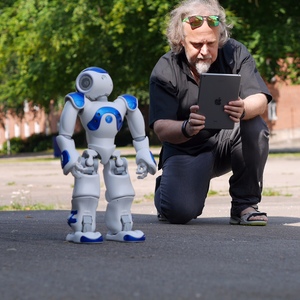
I am a social psychologist by training, but my interdisciplinary work currently focuses on the complex interplay between humans and technology, particularly in social robotics and affective computing. I am interested in the cognitive and emotional processes that underpin human-robot interaction, to support the development of robots that can respond to human behavior across diverse social contexts. Furthermore, my research explores the psychological implications of human-robot relationships, examining how these interactions can influence our emotional experiences and social behaviors. Ultimately, I aim to better understand the gap between humans and machines, fostering a future in which technology enhances human well-being and social connections while accounting for ethical concerns.
Specialties: Psychology of Emotions, Affective Computing, Psychophysiology, Social Robotics, Nonverbal Behavior
I am a fellow of the Association for Psychological Science and the Society for Personality and Social Psychology. I have taken on various roles in scientific societies, such as the Society for Psychophysiological Research, the Association for the Advancement of Affective Computing, and I have been president of the International Society for Research on Emotions (ISRE; 2013-2018). In the past, I have been Associate Editor of the APA journal Emotion and Elsevier's Biological Psychology. In addition, I have been on editorial boards (Cognition and Emotion, Journal of Nonverbal Behavior).
I have been at Constructor University (previously Jacobs University) since 2003, and from 2014 to 2024, I was Dean of Graduate Studies and also responsible for social sciences and humanities (now School of Business, Social and Decision Sciences), as well as computer science.
Primary Interests:
- Communication, Language
- Emotion, Mood, Affect
- Internet and Virtual Psychology
- Interpersonal Processes
- Neuroscience, Psychophysiology
- Nonverbal Behavior
Research Group or Laboratory:
Note from the Network: The holder of this profile has certified having all necessary rights, licenses, and authorization to post the files listed below. Visitors are welcome to copy or use any files for noncommercial or journalistic purposes provided they credit the profile holder and cite this page as the source.
Image Gallery

Video Gallery

The Psychology of (Cyber)Emotions
Select video to watch
-
44:56 The Psychology of (Cyber)Emotions
Length: 44:56
-
19:43 Social Neuro Talks: 21 Questions Interview
Length: 19:43
-
25:47 If Neuroscience Is the Answer, Then What Is the Question?
Length: 25:47
-
0:44 Bildung Beyond Boundaries
Length: 0:44
-
1:00:04 Oh Emotion, You Wondrous Thing!
Length: 1:00:04
Books:
- Calvo, R.A. D'Mello, S. Gratch, J. & Kappas, A. (Eds.) (2015), Oxford Handbook of Affective Computing. New York, NY, Oxford University Press.
- Kappas, A., & Krämer, N.C. (Eds.). (2011). Face-to-face communication over the Internet: Emotions in a web of culture, language, and technology. Cambridge: Cambridge University Press.
Journal Articles:
- Cross, E.S., & Kappas, A. (2026). Social robotics is not (just) about machines. It is about people: Psychology’s role in developing social machines. Annual Review, 77. https://doi.org/10.1146/annurev-psych-040325-025951
- Dukes, D., Abrams, K., Adolphs, R., Ahmed, M. E., Beatty, A., Berridge, K. C., Broomhall, S., Brosch, T., Campos, J. J., Clay, Z., Clément, F., Cunningham, W. A., Damasio, A., Damasio, H., D’Arms, J., Davidson, J. W., de Gelder, B., Deonna, J., de Sousa, R., … Sander, D. (2021). The rise of affectivism. Nature Human Behaviour, 5(7), 816–820. https://doi.org/10.1038/s41562-021-01130-8.
- D’Mello, S., Kappas, A., & Gratch, J. (2018). The affective computing approach to affect measurement. Emotion Review, 10(2), 174–183. https://doi.org/10.1177/1754073917696583
- Kappas, A., & Gratch, J. (2023) These Aren’t The Droids You Are Looking for: Promises and Challenges for the Intersection of Affective Science and Robotics/AI. Affective Science 4, 580–585. https://doi.org/10.1007/s42761-023-00211-3
- Krumhuber E. G., & Kappas A. (2022). More what Duchenne smiles do, less what they express. Perspectives on Psychological Science. 17 (6), 1566-1575. https://doi.org/10.1177/17456916211071083
- Krumhuber, E. G., Swiderska, A., Tsankova, E., Kamble, S. V., & Kappas, A. (2015). Real or artificial? Intergroup biases in mind perception in a cross-cultural perspective. PLoS ONE, 10(9), e0137840. http://dx.doi.org/10.1371/journal.pone.0137840
- Laban, G., Morrison, V., Kappas, A., & Cross, E.C. (2025). Coping with emotional distress via self-disclosure to robots: An intervention with caregivers. International Journal of Social Robotics, 7, 1837–1870 (2025). https://doi.org/10.1007/s12369-024-01207-0
- Pohl, J., Nikolovska, K., Maurelli, F., Kappas, A., & Hommel, B. (2025). Selfhood-attribution in a social context: Further evidence for a pars-pro-toto account. Frontiers in Psychology, 16, 1528172. https://doi.org/10.3389/fpsyg.2025.1528172
- Poluektova, O., Kappas, A., & Smith, C. A. (2023). Using Bandura’s Self-Efficacy Theory to Explain Individual Differences in the Appraisal of Problem-Focused Coping Potential. Emotion Review, 15(4), 302-312. https://doi.org/10.1177/17540739231164367
- Stower, R., Calvo-Barajas, N., Castellano, G., & Kappas, A. (2021). A Meta-analysis on Children’s Trust in Social Robots. International Journal of Social Robotics. 13, 1979-2001. https://doi.org/10.1007/s12369-020-00736-8
- Stower, R., Kappas, A. & Sommer, K. (2024). When is it right for a robot to be wrong? Children trust a robot over a human in a selective trust task. Computers in Human Behavior, 157, No. 108229. https://doi.org/10.1016/j.chb.2024.108229
- Vanman, E.J., & Kappas, A. (2019). “Danger, Will Robinson!” The Challenges of Social Robots for Intergroup Relations. Social and Personality Psychology Compass, 13 (8) . https://doi.org/10.1111/spc3.12489
Other Publications:
- Castellano, G., Paiva, A., Kappas, A., Aylett, R., Hastie, H., Barendregt, W., Nabais, F., & Bull, S. (2014). Towards empathic virtual and robotic tutors. In H C Lane, K Yacef, J Mostow, & P Pavlik (Eds.) Artificial Intelligence in education (pp. 733-736). Berlin, Germany: Springer.
- Kappas, A. (2011). To our emotions, with love: How affective should affective computing be? Affective Computing and Intelligent Interaction 4th International Conference 2011 Proceedings, Part I, Lecture Notes in Computer Science, 6874, 1.
- Kappas, A. (2003). What facial activity can and cannot tell us about emotions. In M. Katsikitis (Ed.), The human face: Measurement and meaning (pp. 215-234). Dordrecht: Kluwer Academic Publishers.
- Kappas, A. (2001). A metaphor is a metaphor is a metaphor: Exorcising the homunculus from appraisal theory. In K. R. Scherer, A. Schorr, & T. Johnstone (Eds.), Appraisal Processes in Emotion: Theory, Methods, Research (pp. 157-172). New York: Oxford University Press.
- Kappas, A., & Descôteaux, J. (2003). Of butterflies and roaring thunder: Nonverbal communication in interaction and regulation of emotion. In P. Philippot, E. J. Coats, & R. S. Feldman (Eds.), Nonverbal behavior in clinical settings (pp. 45-74). New York: Oxford University Press.
- Müller, M. G., & Kappas, A. (2011). Visual emotions – emotional visuals: Emotions, pathos formulae, and their relevance for communication research. In K. Döveling, C. von Scheve, & E. A. Konijn (Eds.), The Routledge Handbook of Emotions and Mass Media (pp. 310-331). Abingdon, OX; UK: Routledge.
Courses Taught:
- Communication and Interaction
- Emotion and Motivation
- Social Neuroscience
Arvid Kappas
Constructor University
Campus Ring 1
28759 Bremen
Germany
- Phone: +49 (0)421 200 3441
- Fax: +49 (0)421 200 3303
